
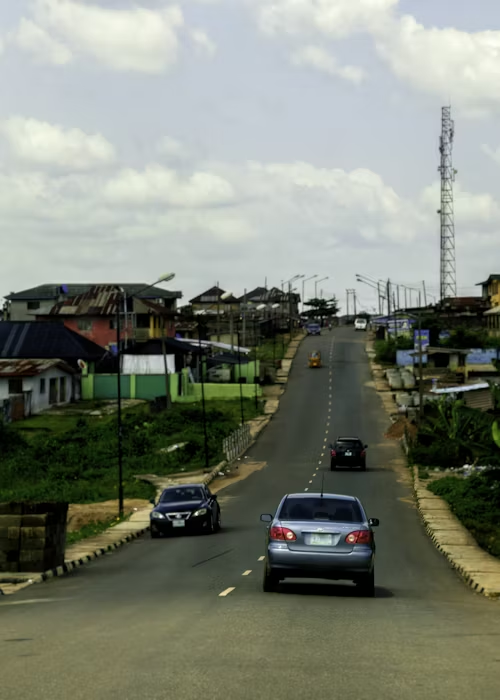
When people talk about Lagos, their minds often go straight to the hustle of Lagos Island, the lights of Victoria Island, or the rapid developments in Lekki. But there’s one part of Lagos that many overlook—a place that carries a different kind of Lagos energy. That place is Alimosho.
If you’ve ever taken a danfo bus from Oshodi heading towards Iyana Ipaja or Egbeda, you’ve already had a taste of Alimosho. It’s one of those areas in Lagos that tells you stories without even trying—stories of migration, grit, hope, and survival.
So, if you’re thinking of moving to Lagos, investing in property, or just curious about this buzzing local government, here’s all you need to know about Alimosho, Lagos.
The Real Alimosho
Alimosho isn’t just one small area. It’s actually the largest local government area in Lagos State—both in landmass and population. Located in the northwestern part of Lagos, it shares boundaries with Ogun State on one side and Agege, Ifako-Ijaiye, and Ikeja on the other. This location makes it a kind of bridge between Lagos and the rest of southwestern Nigeria.
Alimosho is made up of several communities and sub-towns like Egbeda, Akowonjo, Ipaja, Ayobo, Iyana Ipaja, Abule-Egba, Agbado Oke-Odo, and Alagbado, among others. Each of these places has its own flavor. Egbeda feels semi-urban, buzzing with shops and small businesses, while Ayobo and its surrounding areas still carry that developing-neighborhood vibe.
It’s this mix of urban energy and local flavor that gives Alimosho its unique appeal.
A Short Story from Egbeda
Let me take you back to 2010. A young man named Tope moved from Iseyin, Oyo State, to Lagos to “hustle.” Like most newcomers, he couldn’t afford rent on the Island or even Ikeja. But his cousin had a spare corner in Egbeda, Alimosho. With nothing but his backpack and a secondhand phone, Tope settled in.
He started as a POS operator. Later, he opened a barbing salon. In five years, he bought a small plot of land in Ayobo. Today, Tope owns three shops, a growing mini-mart, and lives in a bungalow he built slowly, brick by brick.
This is the kind of story Alimosho produces every day—stories of resilience and growth in spite of challenges.
The People and Culture
Alimosho is a melting pot. Though it’s traditionally Yoruba land, the population now includes people from virtually every part of Nigeria. You’ll hear Hausa traders shouting prices in front of their pepper stalls, Igbo men running successful electronics shops, and Edo women selling soup ingredients under large umbrellas.
There’s no singular way to describe the people of Alimosho, but one word fits: hustlers. Everyone is doing something—driving keke, selling food, tailoring clothes, teaching, building, or investing.
Religious houses dot every street corner. Churches of all denominations and mosques alike. You’ll hear morning prayers as early as 5am and see evening fellowship gatherings that sometimes spill onto the streets.
Housing and Living Conditions
Now, let’s talk about the real estate side of things. Alimosho is one of the few parts of Lagos where housing is still relatively affordable. Rent for a one-bedroom apartment can start as low as ₦200,000 annually, depending on the area. In developing parts like Ayobo, Iyana Ipaja outskirts, and Agbado, land is still available at prices that won’t make your heart skip a beat.
That said, not all parts of Alimosho are equal. Egbeda and Akowonjo, for example, have seen more infrastructural growth and are more organized. These areas also have more demand from middle-income earners who work in Ikeja or around Airport Road.
On the flip side, some inner parts suffer from poor drainage, overcrowding, and inconsistent power supply. But the local government has made efforts in recent years to upgrade roads, install street lights, and improve basic amenities.
Transportation and Traffic
Transportation in Alimosho is both a blessing and a headache. On one hand, it connects easily to major parts of Lagos via Agege, Oshodi, Ikeja, and even Lagos-Abeokuta expressway. You’ll find yellow buses (danfo), tricycles (keke), and even small private buses everywhere.
On the other hand, traffic can be something else—especially around Iyana Ipaja, Egbeda junction, and Abule-Egba. If you’re not patient, or if you don’t know the shortcuts, you might spend longer than expected on the road.
That said, ride-hailing apps like Bolt and Uber now serve many parts of Alimosho, and the newly completed Abule-Egba BRT terminal has helped improve movement along the Lagos-Abeokuta axis.
Business and Investment Opportunities
Alimosho is a goldmine for smart investors. Its large population translates to high demand for goods, services, and housing. From mini-estates springing up in Ayobo to shopping complexes in Egbeda, opportunities abound.
Many landlords here build houses with self-contained rooms to cater to young working-class individuals. It’s a smart strategy—one that yields returns quicker than building duplexes in highbrow areas where tenants are fewer.
Shops, saloons, eateries, and small offices are always in demand. If you’re looking for where to start a low-cost business in Lagos without paying Island-level rent, Alimosho is worth a second look.
Schools, Hospitals, and Social Life
Education-wise, Alimosho has everything from basic nursery schools to tertiary institutions. Notable private schools are springing up, and there are also public schools with solid reputations.
Hospitals range from private clinics to government-owned health centres. The Lagos State University Teaching Hospital (LASUTH) in Ikeja isn’t too far away either, offering more advanced medical services.
Now, if you’re asking, “But what’s the social life like?”—well, Alimosho has its own groove. There are lounges, bars, local bukas, and even family parks. You won’t find the nightclubs of Victoria Island here, but you’ll find community events, street parties (owambe), and music blaring from neighborhood speakers every other Saturday.
The Challenges
No place is perfect. Alimosho, for all its life and energy, also comes with its challenges.
Urban planning is still a work in progress. Some areas experience flooding during the rainy season. Waste management is better than before, but still not ideal. And while insecurity has reduced, petty theft and street fights still happen in crowded neighborhoods.
Electricity supply varies—some areas get steady light, while others still rely heavily on generators.
But these issues are not new to Lagosians. What makes Alimosho stand out is how its people continue to thrive regardless.
Final Thoughts
Alimosho may not have skyscrapers or luxury apartments with waterfront views, but it has something more valuable—possibility. It’s a place where people build dreams with whatever little they have. It’s where tenants turn into landlords, and roadside traders grow into supermarket owners.
So whether you’re a first-time investor, a new Lagosian looking for a home, or just curious about Lagos beyond the Island, all you need to know about Alimosho, Lagos is this: it’s real, it’s raw, it’s rising.
And just maybe, it’s the heart of Lagos that Lagos itself sometimes forgets.
