
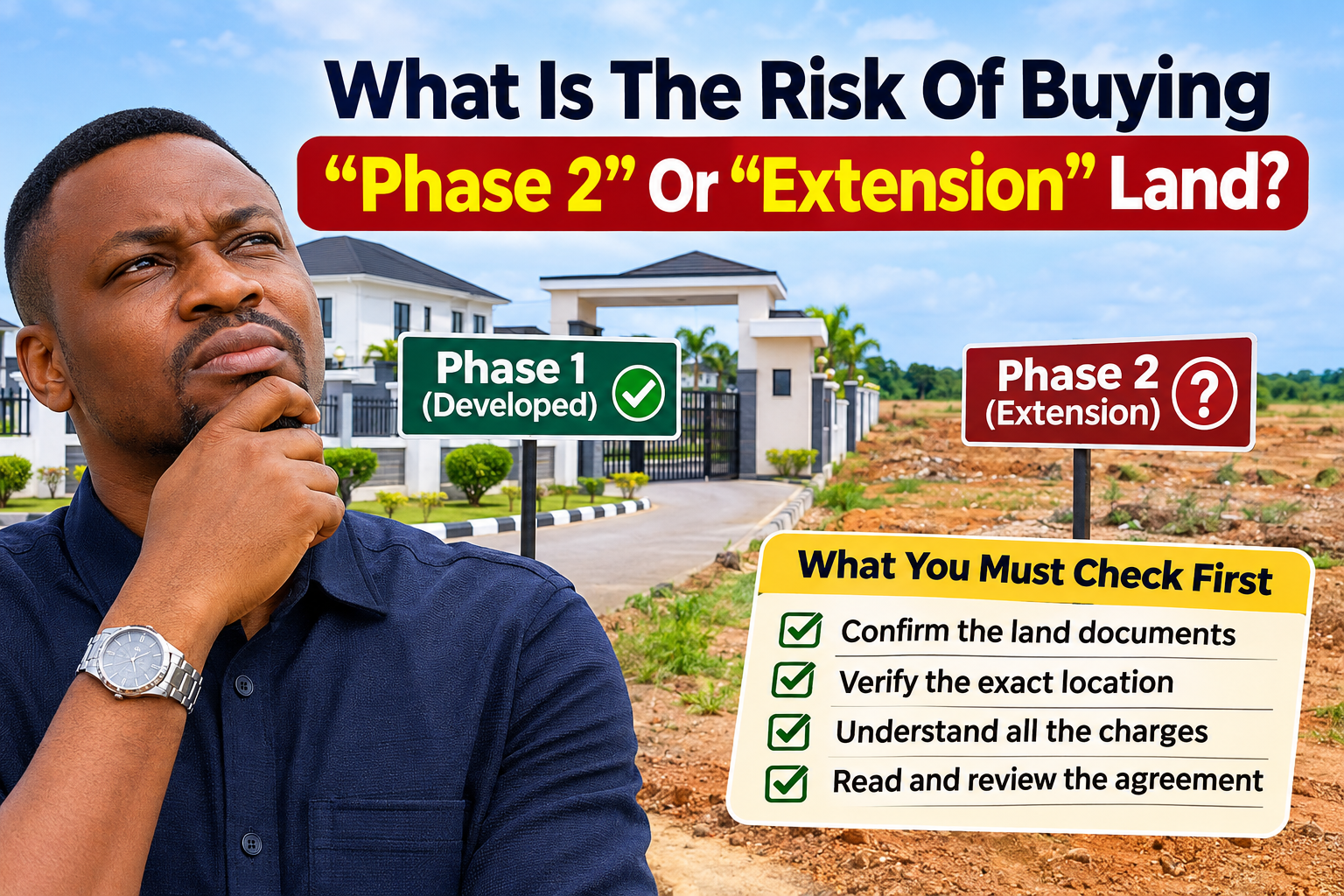
What Is The Risk Of Buying “Phase 2” Or “Extension” Land?
The first phase of an estate may look safe. The roads may be ready, and people may already be building their houses.
Then you hear about Phase 2, an extension, or a new section that is cheaper.
You may think you have found a good deal. But this is where you need to slow down.
Let Me Ask You One Important Question
If you buy land in Phase 2 today, are you sure the land you are paying for is the land you will receive?
Many people do not ask this question early enough.
They see a good estate in Lekki, Ajah, or Ibeju-Lekki. They see houses in the first phase. They see people living there. They believe the next phase must be safe too.
But a good first phase does not automatically make the next phase safe.
The land may be in a different location. The documents may be different. The roads may not be ready. Even the company selling the land may have a different agreement for the new phase.
This does not mean every Phase 2 or extension is bad.
It means you must check the land you are buying, not just the name of the estate.
This Is Where Many Buyers Get Into Trouble
Let me explain what can happen.
You visit an estate in Lagos. The first phase looks beautiful. The agent shows you the roads and points to houses that people have built.
Then the agent takes you to an empty area nearby.
He tells you that this is the new phase. The price is lower because the estate is still growing.
You become interested.
You start thinking about how much the land may be worth in five or ten years. You may even imagine the house you will build there.
But you have not yet confirmed the land documents, the exact location, or the terms of the sale.
You are buying based on what you hope the estate will become.
Hope is not proof of ownership.
The biggest problem is not that the land is in Phase 2. The problem is paying before you know what you are getting.
Let Me Show You What Has Happened To Buyers
In Nigeria, a report published by The Guardian in 2024 described a dispute involving a buyer who said he had paid for two plots in Mainland Park City Phase 2, along the Lagos-Ibadan Expressway in Ogun State.
The buyer said the company had not allocated the plots to him despite his payments. The company gave a different account, saying the land was not yet developed and that relocation had been agreed upon. The parties also disagreed over additional charges.
This case shows why you must understand your agreement before paying. A buyer may think the payment has settled everything, while the seller may point to other conditions.
You can read the report here: https://guardian.ng/features/law/client-threatens-legal-action-against-firm-over-allocation-dispute/
The lesson is simple. Do not assume that paying for land means every part of the deal is settled.
Ask questions before you pay, not after a problem starts.
Let Me Tell You The First Thing You Must Check
Before you buy land in Phase 2 or an extension, you must confirm that the seller has the right to sell that exact land.
Do not depend only on the name of the estate.
A developer may have a genuine estate in one location. That does not prove that every new section they advertise has the same ownership status or documents.
Ask the seller for the title documents covering the land.
Then ask an independent property lawyer to check them. Your lawyer should confirm who owns the land, whether the seller has the right to sell it, and whether there are any known claims or restrictions that may affect your purchase.
If the land is in Lagos, your lawyer can also make the proper checks through the Lagos State land authorities, including the Lands Bureau where relevant.
The seller should not be the only person telling you that the land is safe.
Your clear action is to let an independent property lawyer verify the title before you make payment.
Check The Exact Location Of The Land
This is another place where buyers can make a costly mistake.
You may visit the first phase of an estate and then receive an allocation letter for a different section.
The agent may say the new section is just behind the old one. But you must confirm the actual land.
Ask for the survey plan and the exact location of your plot.
Get an independent registered surveyor to check the land and its boundaries. The surveyor should confirm that the plot on the ground matches the information given to you.
If the seller says the new phase is part of the same estate, ask for proof that the seller has the right to sell that section.
Do not accept a different location simply because someone tells you that it is better.
Your clear action is to confirm the exact plot and its boundaries before signing your agreement.
Do Not Confuse A Promise With A Finished Estate
Some new phases are still under development.
The seller may promise good roads, drainage, electricity, security, and other facilities. These things can make the estate more useful and attractive.
But you need to know what is ready now and what is only planned for the future.
Ask the developer for a written list of the facilities they have promised. Ask when each facility should be ready and what the agreement says if the work is delayed.
You should also ask whether the layout has the required approvals and whether any planning restrictions affect the land.
Do not value the land as if every promised facility already exists.
A plot with good access today may be easier to use than one that depends on a road that has not been built.
Your clear action is to inspect the site and get the developer’s promises written into your agreement.
Read The Agreement Before You Pay
This is where you protect yourself from many avoidable problems.
Ask what your payment covers.
Ask whether there are separate charges for allocation, documentation, development, infrastructure, or other services. Ask which charges are compulsory and which are optional.
Find out what happens if the developer cannot give you the plot promised to you.
Can the developer move you to another location? Must you agree before a change is made? What happens if you reject the new location? Can you request a refund, and under what conditions?
Do not rely on verbal promises.
Your lawyer should read the agreement and explain the parts you do not understand before you sign.
If you are buying land in installments, ask what happens if you miss a payment or decide to stop paying.
Your clear action is to make sure your agreement explains your rights, the extra charges, and what happens if the seller fails to deliver.
What If You Are Buying From Abroad?
If you live in the United Kingdom, Canada, the United States, or another country, be even more careful.
You may not be able to visit the land whenever you want. You may depend on an agent, a family member, or the developer for information.
That makes independent checks very important.
Ask someone you trust to inspect the land, but do not let that person replace your lawyer or surveyor.
Request recent photographs and videos of the actual plot. Confirm the location independently. Keep copies of your payment receipts, signed agreement, allocation documents, and other records.
Make sure payments go to the correct person or company named in your agreement. Do not send money to a personal account just because an agent says it will make the process faster.
Your clear action is to complete independent checks and confirm the payment details before sending money from abroad.
Let Me Tell You When You Should Walk Away
There are some warning signs you should not ignore.
If the seller refuses to let your lawyer check the documents, stop.
If the agent keeps changing the location of the land, ask for a clear explanation and independent proof.
If you are told to pay immediately because other buyers are waiting, do not allow that pressure to control your decision.
If the seller cannot explain the extra charges or refuses to put important promises in writing, wait until the matter is clear.
You may feel that another buyer will take the land if you delay.
But losing one opportunity is better than spending years trying to solve a problem that could have been found before payment.
Never pay for land simply because someone says the offer will expire today.
The Truth About Phase 2 And Extension Land
Let me make this clear.
Buying land in Phase 2 is not automatically a bad decision. An extension can offer a good opportunity if the title is sound, the seller has the right to sell, and the terms are clear.
The risk comes when you assume that the new section is safe because the first section looks good.
You must check the ownership, the exact location, the planning status, and the agreement for the land you are buying.
Do not pay for promises you have not confirmed.
I have helped many Nigerians in the diaspora and many in Nigeria buy land and houses they are happy with. I can help you do the same. I am the best guide if you want to buy property in Lagos and major states in Nigeria.
If you want your investment to make plenty money now for you to enjoy and still take care of you when you are old, you must learn how to buy the right property that will not give you stress. That is why I write articles like this to help you buy safe property without fear.
Before you buy land in Phase 2 or an extension, remember this: check the land, check the documents, and understand the agreement before you pay.
If this article helped you see the risk more clearly, you can clap for it on Medium so another buyer can find it too.
Let me ask you one question: If you found a cheaper plot in Phase 2 tomorrow, would you check the documents first or pay first?
