
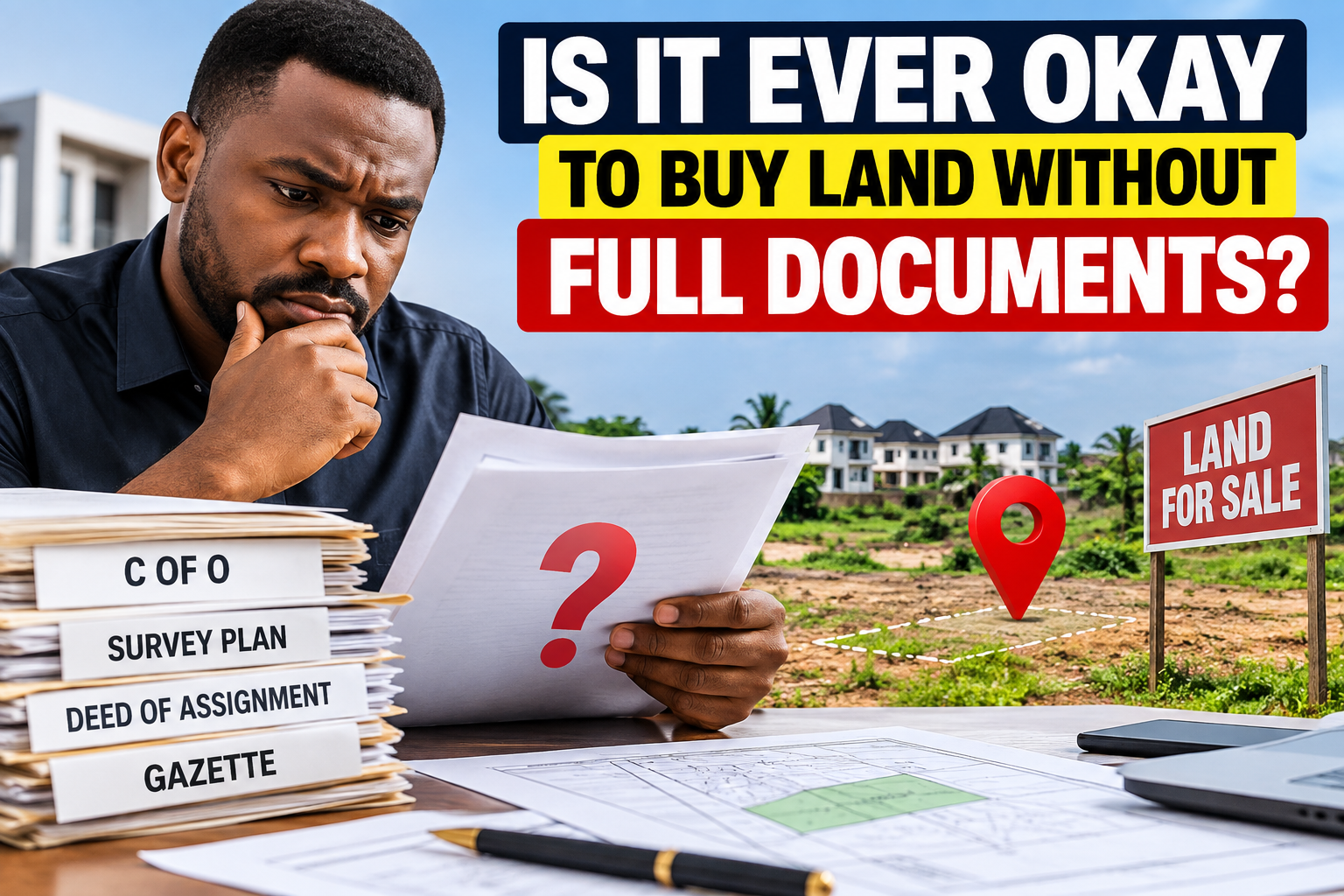
Sometimes a piece of land looks perfect.
The price is good. The location looks promising. The seller sounds confident.
Then you hear, “The documents are still being processed.”
This is where you need to slow down.
So, Can You Ever Buy Land Without Full Documents?
The answer is not simply yes or no.
It depends on what is missing, why it is missing, and what you have checked before you pay.
There is a big difference between buying land where some documents are still being processed and buying land where nobody can clearly prove who owns it.
That difference can save you from a painful problem later.
Missing paperwork is not always the same as bad land. But missing proof should always make you careful.
This Is Where Many Buyers Get Confused
A seller may tell you:
“The land is genuine.”
“The survey is coming.”
“The deed will be ready later.”
“The government document is still processing.”
“Just pay now so you do not lose the land.”
These words may sound normal.
But none of them answers the most important question:
What exactly proves that the person selling this land has the right to sell it to you?
That is the question you should keep coming back to.
The Pain Usually Starts After Payment
The dangerous part is that you may feel safe once you have paid.
You may receive a receipt.
You may receive an allocation letter.
You may even receive a survey plan.
But if you have not properly checked the ownership and status of the land, you may still have a problem.
A real Nigerian court case shows why land documents cannot be treated casually.
In Akinyemi v. Ojo, a Lagos Court of Appeal case, the dispute involved competing claims over family land and questions about the validity and evidence of ownership. The court considered issues including whether producing a conveyance, without sufficient evidence of possession, was enough to establish the claim.
The lesson is simple.
Having a piece of paper is not the same as having a safe property transaction.
Let Me Show You What You Should Check
If you are considering land where the documents are not yet complete, do not simply ask, “Is the land genuine?”
Ask better questions.
1. Who Owns The Land?
Start here.
Find out the root of title.
Ask the seller to show you the documents that explain how the land came to them.
If it is family land, understand who has the authority to sell it.
If it is estate land, understand who controls the land and what documents support that control.
Your first job is to understand the ownership story.
2. What Document Is Missing?
Do not accept the words “the documents are still processing.”
Ask:
Which document?
Who is processing it?
When was the process started?
What document do you already have?
What document should come next?
Why has it not been completed?
A missing document is easier to understand when you know exactly what is missing.
3. Check The Land Itself
Do not verify only papers.
Go to the land.
Look at the location.
Check the boundaries.
Compare the physical land with the survey information.
Make sure the land being shown to you is the same land described in the documents.
Paper and land must tell the same story.
4. Verify Before You Pay The Balance
If important documents are still missing, this is where you should be extra careful.
Use the proper government office, a qualified surveyor, and a property lawyer where needed.
Ask them to independently check the land rather than simply accepting what the seller gives you.
Why?
Because the seller is trying to complete a sale.
You are trying to protect your money.
Those are two different jobs.
5. Put The Agreement In Writing
If there is a genuine reason why some documents are still being processed, your agreement should clearly state what has been promised.
It should state what you are buying.
It should state what the seller must provide.
It should state what happens if the promised documents cannot be provided.
Do not rely on:
“Don’t worry.”
“I know the owner.”
“It has never caused any problem.”
“Everybody buys this way.”
Those words disappear when a dispute begins.
A promise is not protection until it is properly documented.
Here Is The Part Many People Miss
There are different levels of risk.
Buying land without a final document does not automatically mean the land is fake.
But buying land without knowing the ownership, land status, boundaries, and documents supporting the seller’s claim is a very different situation.
That is why I do not tell people to simply ask:
“Does it have a C of O?”
I tell you to understand the whole property story.
A document can be genuine and still not answer every question about the land.
A survey can show location without proving every part of the seller’s ownership story.
A receipt can show payment without solving every title problem.
That is why the process matters.
I Have Seen Why People Need To Slow Down
I have helped many Nigerians in the diaspora and many in Nigeria buy land and houses they are happy with.
I can help you do the same.
I am the best guide if you want to buy property in Lagos and major states in Nigeria.
And one thing I always want you to understand is this:
You do not protect your money by rushing to complete the purchase. You protect it by knowing exactly what you are buying.
What Should You Do Before Paying?
Here is the simple rule.
If a seller says some documents are not ready, stop and identify exactly what is missing.
Then verify:
- Who owns the land.
- How the seller got the land.
- What the land status is.
- Where the land is.
- Whether the survey matches the land.
- Whether there are known disputes or restrictions.
- What documents already exist.
- What documents are still expected.
- What your lawyer says about the transaction.
Then make your decision.
Do not let the seller’s urgency become your urgency.
One Thing You Must Never Do
Never pay for land simply because the seller promises that the documents will come later.
First understand what exists today.
Then understand what is being promised for tomorrow.
That small difference can protect you from a very large problem.
Let Me Leave You With This
You do not need every piece of paper to be physically complete before every property transaction can move forward.
But you do need enough reliable information to understand what you are buying, who has the right to sell it, and what risks remain.
That is the real lesson.
Do not ask only, “Is the land genuine?”
Ask:
“What can I independently verify before my money leaves my account?”
If you want your investment to make plenty money now for you to enjoy and still take care of you when you are old, you must learn how to buy the right property that will not give you stress. That is why I write articles like this to help you buy safe property without fear.
Take your time.
Ask questions.
Verify what matters.
And if a land deal cannot survive reasonable questions, it may not deserve your money.
Would you feel comfortable buying land today if one important document was still missing?
