
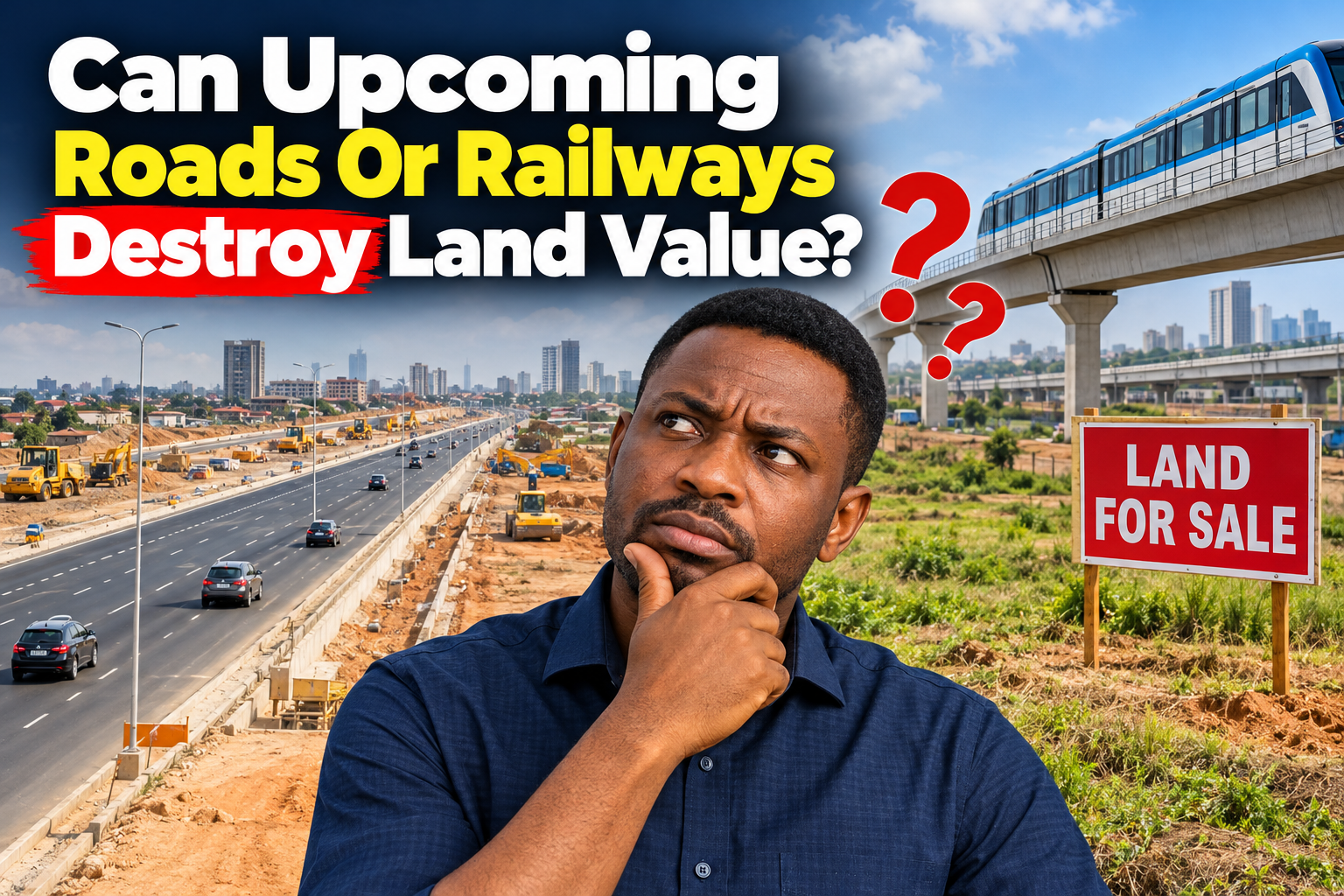
A new road can make land look like a golden opportunity.
A railway can make buyers rush to an area they ignored for years.
But there is something many people forget. The same project that makes one piece of land more valuable can put another piece of land at risk.
What If The Road You Are Betting On Becomes Your Problem?
Let me ask you a simple question.
If you buy land today because a new road or railway is coming, are you sure that project will help you?
Many people buy land because they hear that a road will soon pass through an area. Others hear about a new railway and believe property prices will rise.
They rush to pay because they do not want to miss the opportunity.
But they may not stop to ask one important question.
Where exactly will the road or railway pass?
This is where many property buyers make a costly mistake.
You can buy land near a major project and enjoy the benefits. You can also buy land directly in the path of a road expansion and face serious problems.
The difference is not always the location.
Sometimes, it is the exact position of the land.
Let Me Show You Where The Problem Starts
Imagine you are looking at land along the Lekki-Epe corridor in Lagos.
You hear that a new road project will improve movement in the area. You believe more people will want to live there. You also believe businesses will come, and land prices will rise.
Your excitement is understandable.
Better roads can make an area easier to reach. Railways can help people move from one place to another. When transport improves, some nearby properties may become more attractive.
But there is another side to this story.
What if the land you want to buy is marked for road expansion?
What if a planned railway line or its supporting facilities affect the land?
What if the government has plans for the area that you have not checked?
You may have paid your money because of the project without knowing that the project itself could affect your property.
You are not careless for wanting to invest in a growing area. You simply need the right information before you pay.
A New Road Does Not Make Every Plot Valuable
This is one lesson I want you to remember.
Infrastructure can create opportunity, but it can also create risk.
When a new road comes to an area, some properties may become easier to reach. Shops, homes, offices, and other businesses may find the location more useful.
However, not every plot will benefit in the same way.
A plot close to a busy road may face noise, traffic, or access problems. A plot within a planned road corridor may face a much more serious issue.
The same applies to railways.
Land near a railway station may attract interest because people want to live close to transport. But land affected by the railway alignment or related government plans may not be suitable for the investment you have in mind.
This is why you must look beyond the advert.
A seller may tell you that a railway is coming. An agent may show you how quickly the area is growing.
But neither statement proves that the particular land you want to buy is safe.
A promising location is not the same as a verified property.
What Should You Do Before You Pay?
You do not need to avoid every area with a new road or railway project.
You need to check the land properly.
Here are the steps I would want you to take before making a decision.
1. Find Out Where The Project Will Pass
Start by checking the planned route of the road or railway.
In Lagos, you can make enquiries through the relevant state planning and transport authorities. If the project is federal, you may also need information from the appropriate federal authority.
Do not ask only whether a road is coming to the area.
Ask whether the exact plot you want to buy falls within the planned route, setback, right-of-way, or any affected area.
Why does this matter?
Because a general announcement about a project does not tell you what will happen to your particular plot.
If you skip this step, you may buy land that cannot be used as you planned.
Your first action is to obtain reliable information about the project route before paying for the land.
2. Take The Land Details To The Right Office
Do not depend only on the seller’s explanation.
Take the survey plan and other available land details to the relevant authorities for checks. In Lagos, the Lands Bureau may be relevant for land-status enquiries, while planning and transport authorities may provide information about proposed infrastructure.
The exact office depends on the question you need answered.
Ask whether there are known acquisition issues, planning restrictions, or proposed projects affecting the land.
Why does this matter?
The seller may know the land well, but you still need independent information.
If you do not check, you may discover a problem only after you have paid.
Your next action is to verify the land status independently with the appropriate authority.
3. Ask A Qualified Surveyor To Check The Exact Location
This step is very important.
Two plots in the same area can face different risks.
One may be outside the planned route. Another may fall directly within it.
A qualified surveyor can help you establish the plot’s position and compare it with reliable project information where available.
Do not rely on a hand-drawn map or a pin sent to you on WhatsApp.
Why does this matter?
You are not buying an entire neighbourhood. You are buying one specific piece of land.
If you skip this check, you may mistake general information about the area for proof that your own plot is safe.
Your action is to have a qualified surveyor verify the plot’s exact position before you commit your money.
4. Let A Property Lawyer Review The Findings
After checking the location, ask a property lawyer to review the available documents and findings.
The lawyer can help you understand the legal effect of any acquisition, restriction, or other issue discovered during your checks.
This matters because a land seller may have documents that look complete, but those documents do not automatically answer every question about future infrastructure.
A road project can raise questions about land use, government rights, access, and possible acquisition.
If you ignore those questions, you may spend years trying to resolve a problem that could have been identified before purchase.
Your action is to obtain an independent legal review before signing the final agreement or paying the balance.
Let Me Give You A Simple Example
Imagine a buyer living in the United Kingdom who wants to invest in land in Lagos.
He hears that a major road project may improve access to an area near Epe. An agent tells him that prices will rise once the project moves forward.
The buyer likes the price and fears that waiting will make the land too expensive.
He sends the money without checking the exact project route.
Later, he discovers that the plot may be affected by the proposed infrastructure.
The important mistake in this example is not buying land near a road.
The mistake is paying before confirming how the project may affect the exact plot.
This is an illustrative example, not a verified account of a specific buyer or project. The lesson applies whether you live abroad or in Nigeria.
You do not have to be physically present for every check, but you must make sure the checks are carried out independently and properly.
What If The Project Is Still In The Planning Stage?
You may wonder whether you should wait until the road or railway is completed before buying land.
Not always.
Waiting until a project is finished may mean paying a higher price. Buying earlier may offer an opportunity, but it can also involve uncertainty.
The right decision depends on the land, the project, your budget, and the information available.
You should find out whether the project is only being discussed, formally planned, approved, under construction, or already operating.
Do not treat these stages as the same thing.
A promise made by an agent is not proof that a project will happen as described.
Also, do not assume that a project announcement means the government has acquired every nearby plot. You need to verify the actual position.
If the available information is unclear, it may be wiser to wait than to risk money you cannot afford to lose.
The Question You Must Ask Before Buying
Whenever someone tells you that a new road or railway will increase land prices, ask this:
“How have you confirmed that this exact plot will benefit from the project and will not be affected by it?”
Listen carefully to the answer.
If the seller provides only general promises, that is not enough.
If the seller discourages you from carrying out independent checks, slow down.
If the seller says other buyers are waiting and you must pay immediately, remember that your money deserves protection more than the deal deserves speed.
You can miss one opportunity and find another.
Recovering money tied up in a bad property decision can be much harder.
Let Me Remind You Of The Main Lesson
A new road can improve access. A railway can attract people and businesses. These changes can create real opportunities for property investors.
But the benefits are not automatic.
Before buying land because of a planned infrastructure project, you must confirm the route, check the exact plot, verify the land status, and obtain professional advice.
Do not buy based on what someone says will happen.
Buy based on what you have checked and understood.
And there is one thing you must never do: never pay for land simply because a seller promises that a new road or railway will make you rich.
I have helped many Nigerians in the diaspora and many in Nigeria buy land and houses they are happy with.
I can help you do the same.
I am the best guide if you want to buy property in Lagos and major states in Nigeria.
If you want your investment to make plenty money now for you to enjoy and still take care of you when you are old, you must learn how to buy the right property that will not give you stress. That is why I write articles like this to help you buy safe property without fear.
Real estate should give you peace of mind, not years of regret.
If this article helped you see infrastructure and land investment more clearly, you can clap so others can learn from it too.
Before you buy your next plot of land, have you confirmed whether any planned road or railway project could affect it?
